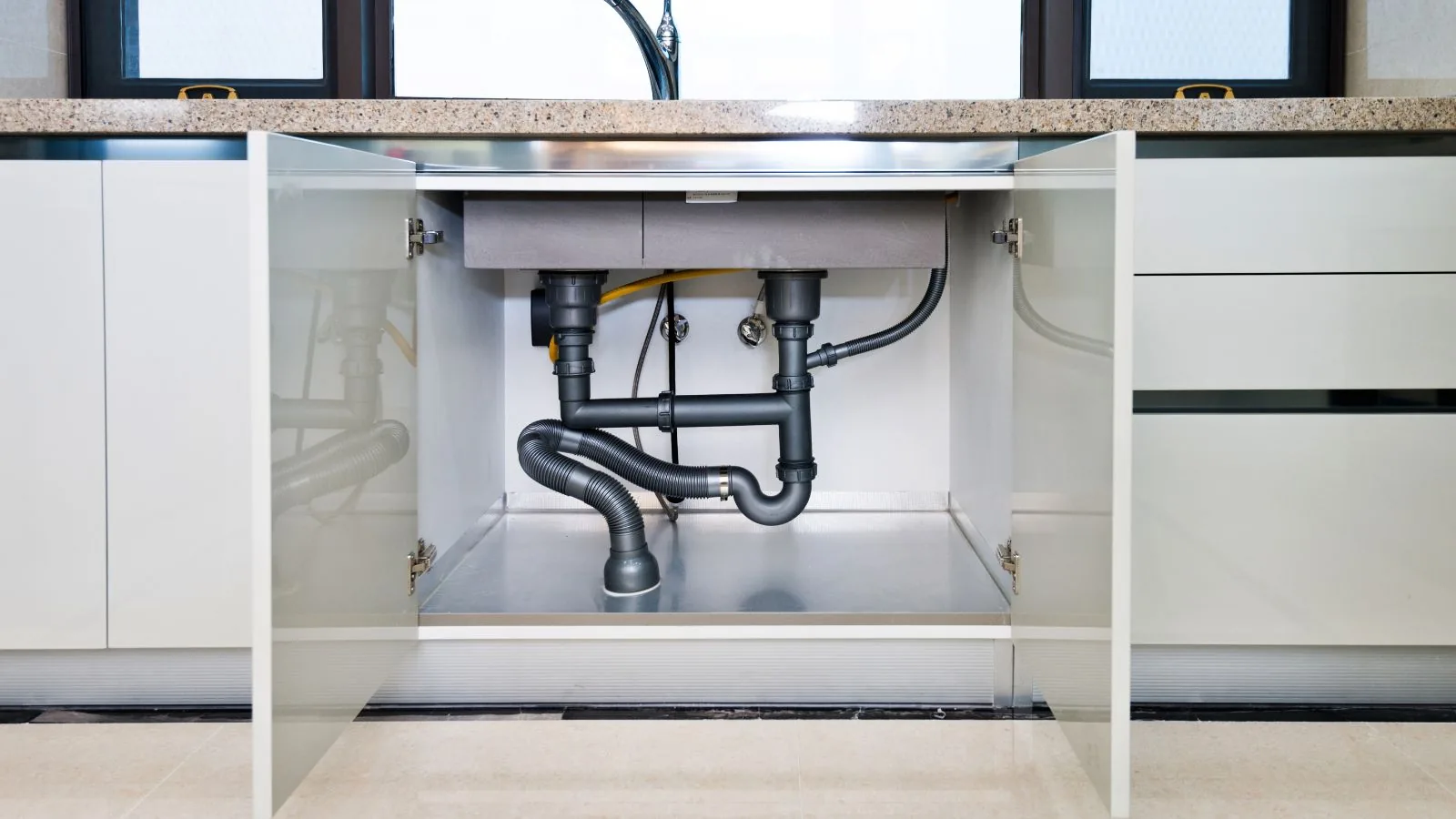
Kitchen water damage repair in Attleboro, MA covers a room where water arrives from many directions. A sink supply line, a dishwasher hose, a refrigerator ice maker line, a disposal and a faucet all sit within a few feet of each other, and they share cabinets, a subfloor and one or two walls.
A leak in a kitchen is often discovered late. It runs behind a toe-kick or under a dishwasher, soaks the underlayment and shows up weeks later as a soft floor, a swollen cabinet base or a musty smell when the cabinet doors are opened.
Where kitchen water goes
| Source | Where the water travels | What gets damaged |
|---|---|---|
| Under-sink supply or drain | Cabinet floor, then the subfloor beneath | Cabinet base, particleboard, flooring |
| Dishwasher hose or door seal | Under the unit and along the floor edge | Flooring seams, toe-kick, subfloor |
| Refrigerator ice maker line | Behind and under the fridge | Flooring and wall base, often unseen for a while |
| Faucet or countertop seam | Down the cabinet face and into the floor | Cabinet sides, drawers |
Hidden sources are why a moisture meter is part of every kitchen assessment.
What cleanup and drying look like
Close the shutoff valve under the sink or at the appliance, then remove items from the cabinet. The crew pulls the toe-kick, checks the floor and wall bases with meters and thermal imaging, and opens whatever has to be opened to dry it.
Particleboard cabinets swell when wet and do not return to shape, so a saturated cabinet base is often removed while solid wood and plywood boxes can sometimes be dried. Flooring decides the next step. Vinyl and laminate seams can trap water, and the hardwood floor page explains why wood needs controlled drying.
Leak behind the cabinets?
Call and describe the appliance, the flooring and how long the water ran.
Kitchen leaks are handled across Attleboro, and crews also go to North Attleboro, Mansfield, Rehoboth and Seekonk, along with North Dighton.
Before you clean up the kitchen
Close the supply valve under the sink or behind the appliance, and switch off the dishwasher, refrigerator or range only if you can reach the outlet without standing in water.
Lift food and small items off wet counters and floors, photograph cabinets and flooring, and leave toe-kick panels and cabinet bases in place for the crew to open and read.
ANSI/IICRC S500 is the reference for drying cabinets, subfloors and walls in a wet kitchen.
Small kitchen leaks worth checking now
A damp cabinet base, a slow drip under the sink, a rust ring on a supply valve and a floor that feels soft near the dishwasher are early signs. Check under the sink with a flashlight twice a year and look behind the refrigerator when you move it.
Replace old braided supply lines and ice maker hoses on a schedule your manufacturer suggests, and know where the shutoff valves are. A small repair now can prevent a large drying job later.
Cabinets, countertops and what can be saved
- Solid wood and plywood boxes can often be dried, while particleboard that has swollen usually cannot.
- Countertops are rarely harmed by water but may have to be lifted when the cabinet under them is replaced.
- Toe-kicks, drawer bottoms and the back of sink bases are the first places to show water damage.
- Flooring that continues under the cabinets is the part most often left wet.
Repair after drying means replacing what cannot be saved, and the crew explains which parts are restoration and which are cabinetry or finish work.
What affects the scope
| Factor | How it changes the job |
|---|---|
| Time the leak ran | Days wet the subfloor and cabinets, minutes may not. |
| Cabinet material | Particleboard and plywood respond differently to water. |
| Flooring | Tile, vinyl, laminate and wood each need their own approach. |
| Wall involvement | A wet wall behind the sink adds drywall and insulation steps. |
| Appliance repair | A plumber or appliance technician fixes the source. |
A written scope with the price is explained before work, and (833) 521-1033 is the line for questions.
Insurance and kitchen leaks
A sudden appliance or supply line failure is often treated differently from a long, slow drip under a sink. Photograph the cabinet, the floor and the appliance, keep the failed part if you can, and ask your insurer how the cause affects coverage.
Older Attleboro kitchens
The Massachusetts Historical Commission survey describes many older houses and multi-family buildings across the city, and older kitchens often have a patchwork of plumbing added over decades. A kitchen in a converted two-family may share a wall and a drain with the unit above or below, so a leak can show up in a neighbor's ceiling.
Kitchen leaks in Plainville, Norton and Mansfield are handled the same way, and so are those in North Dighton. For a leak that reached the room below, the ceiling page explains what happens next.
Common questions
Can wet kitchen cabinets be saved?
Solid wood and plywood often can with proper drying. Particleboard that has swollen generally cannot, and the crew checks before deciding.
How do I find a hidden leak under the sink or dishwasher?
Look for staining, soft flooring, a musty smell inside the cabinet and a rising water bill. A moisture meter and thermal camera locate wet areas without opening everything.
Does a kitchen leak need a plumber first?
Yes, the source must be fixed. Shut off the valve, call a plumber or appliance technician and then plan drying and repair.
Will the floor under the cabinets dry on its own?
Rarely. Water trapped under cabinets and flooring stays there, which is why readings are taken before anything is closed up.